
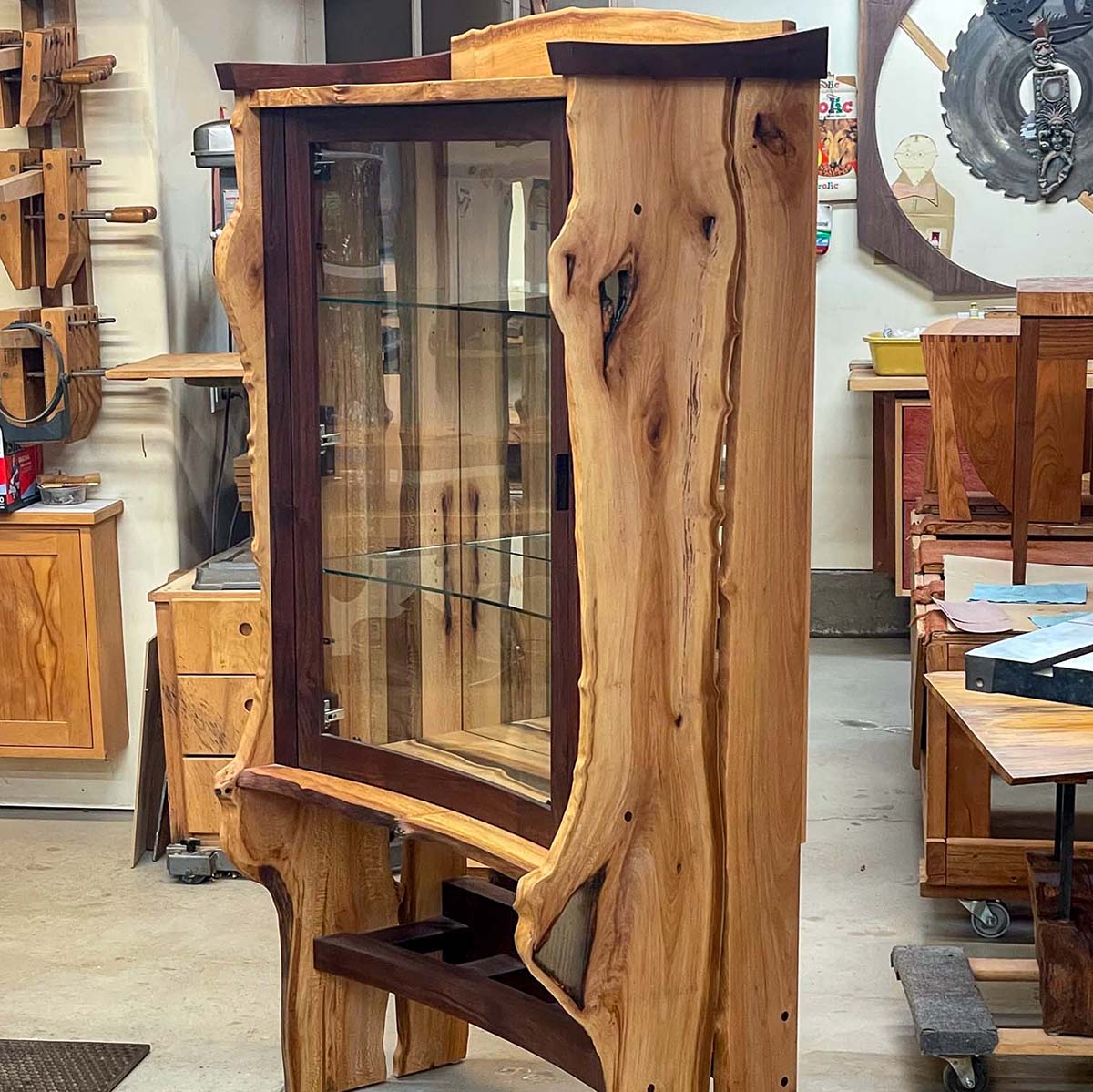
Last Friday we delivered several new pieces to the Highlight Gallery in Mendocino. Highlight has represented us for years, and many of you know it well. It’s always a pleasant jaunt up from Napa, and this time I was particularly happy to re-encounter an older piece of ours that’s on display at the gallery.
The Family Tree Display Cabinet, as it is called, is made principally from natural-edged lumber from a sycamore tree that grew next to our driveway for many years, before it was crowded out by its neighbors. The tree never got very big, so when we milled it into boards we cut all the way through the log, without any board being wider than about 12 inches. So all the boards had long natural edges on both sides, which we preserved carefully from damage in order to incorporate them into the finished cabinet, where they are integral to the design.
A natural edge on a piece of furniture is something that you didn’t see when I was a young woodworker – except in a very rustic setting. However, over the decades that has changed, and natural edges are completely at home in quite elegant settings as well. Tastes have changed; something similar has happened to knots and other irregularities in a board, which have ceased to be defects and are now features to take advantage of.
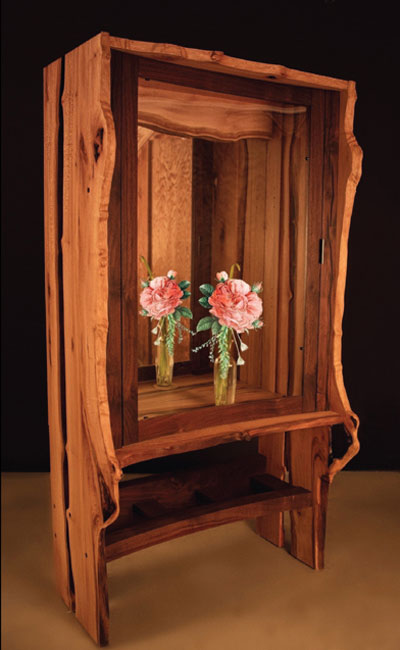 Natural edges seem to add a range of associations to an object made of wood. A natural edge can represent an assertion of the material in its irregularity in the face of geometric regularity. This is somewhat like making art with found objects, when the characteristics of the object are used as design inspiration. This is the way I thought of it at first, as a kind of political assertion claiming enhanced status for natural irregularities; when I was growing up wood furniture was geometrically defined in terms of shapes, and the lines that came from nature appeared in the wood figure only, but now they get to challenge the geometry. So there is a philosophical meaning to be found in the novelty of a natural edge. We are rooting for nature in its struggle against human depredations by giving it an expanded role in the design of things and by allowing the traces of this expanded role to access all the infinite variability of nature.
But after you get used to seeing more natural edges, as we do nowadays, you begin to notice that natural edges also bring a variety of specific emotional associations derived from remembered experiences in a natural setting: pleasant walks, a familiar tree, or an encounter with an interesting-shaped stick when you were a child. These are personal associations, so they are potentially quite powerful, and they are made more pointed by the concrete uniqueness of the piece featuring the natural edge.
And as you get even more used to seeing them, complex natural edges seem to make friends with ornate older furniture styles, both of them contrasting strongly with the brutalist architecture of so many modern buildings. To my eye, this cabinet with its curves and suggested curlicues evokes furniture from long ago, perhaps the age of Louis XIV.
0 Comments